
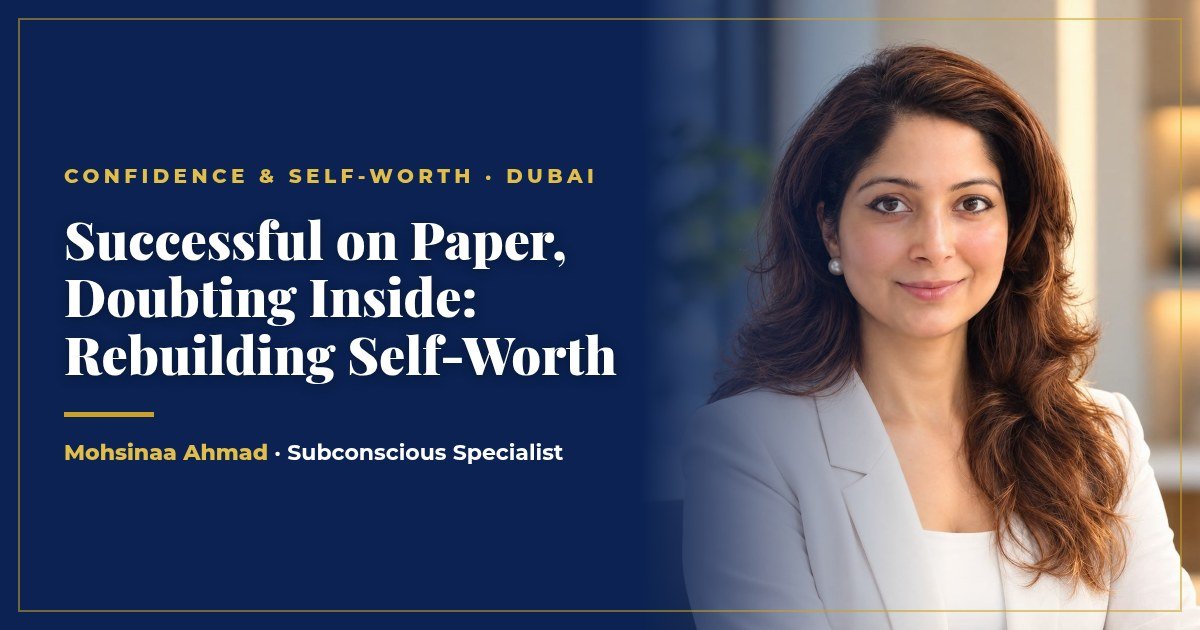

On paper, your life looks like success. You hold a senior role or run your own business. People ask for your advice. Your family is proud of you. And yet there is a quiet, persistent voice that says you’re not quite enough. That you were lucky. That the next mistake might reveal the truth.
Many accomplished people in Dubai carry this voice. Most never mention it, because from the outside it would sound absurd. On the inside, it can be exhausting.
Achievement and worth are not the same thing
Self-worth is your basic sense that you are valuable as a person. Confidence is your belief in your ability to do things. Achievement is what you actually accomplish. The three are often treated as one, but they’re different, and the difference matters.
Many high achievers built their confidence and achievements on top of fragile self-worth. As children, they learned that approval came after good grades, good behaviour or good results. The subconscious conclusion was simple: “I’m worthy when I perform.”
That belief can drive remarkable success. It also guarantees that the success never feels secure, because worth has to be earned again tomorrow.
The hidden costs of conditional self-worth
You can’t rest
When your value depends on performance, rest feels dangerous. Holidays come with guilt. Weekends become another place to be productive.
Criticism feels like a threat
Feedback on your work lands as a verdict on you. You may become defensive, or you may replay the comment for days.
Success brings relief, not joy
A big win produces a brief sense of relief before the pressure for the next one begins. The finish line keeps moving.
You shrink in certain rooms
In front of certain people, perhaps a powerful client, a senior leader or a family elder, you feel smaller than your experience justifies.
Why the voice gets louder in Dubai
Dubai rewards ambition and makes comparison effortless. Your network is full of people building, launching and expanding. Social media shows everyone’s highlights. In a city where the bar keeps rising, conditional self-worth has endless material to work with.
Many residents are also living far from the people who knew them before the titles and achievements. Without those roots, it’s easy to start believing that your accomplishments are the only thing that defines you.
Signs your self-worth needs attention
- You find it hard to accept compliments without deflecting them.
- You compare yourself constantly, and usually come out behind.
- You over-prepare to avoid any chance of being exposed.
- You say yes when you want to say no.
- You feel uneasy when you have nothing to achieve.
If several of these feel familiar, it’s not a weakness. It’s a pattern, and patterns can change.
Feel as worthy as your achievements say you are
Book a free, confidential clarity call with Mohsinaa Ahmad, Subconscious Specialist, to explore what is really holding you back. Or join the free Quantum Leaders WhatsApp community first.
Building self-worth that doesn’t depend on results
Separate who you are from what you do
Start noticing when you speak about yourself only through roles and results. Ask: “If I lost this title tomorrow, what would still be true about me?”
Notice the original belief
Most conditional self-worth can be traced to a specific belief, for example “I have to be the best to be loved” or “Mistakes make me unlovable.” Naming the belief takes away part of its power.
Work beneath the surface
Affirmations repeated over an old belief often feel hollow, because the subconscious doesn’t believe them. Lasting change comes from releasing the original belief and installing a new one, so that worth feels natural rather than argued for.
Practise receiving
Accept a compliment with a simple “thank you”. Take an afternoon off without earning it first. These small actions teach your nervous system that you are safe without performing.
A gentle experiment for this week
For the next seven days, end each evening by writing down one thing you appreciated about yourself that had nothing to do with results. Perhaps you were patient with a colleague, honest in a difficult conversation or kind to yourself after a mistake. It may feel awkward at first. That awkwardness is the old belief noticing that it is being questioned. Over time, this small practice helps your mind register that your value exists outside your output.
You are allowed to feel as good as you look on paper
The goal isn’t to stop achieving. It’s to achieve from a place of wholeness instead of a place of proving. Many people find they become more creative, decisive and generous when they no longer need every result to confirm their value.
The 7-Day Magnetic Identity Code works directly on self-doubt, imposter syndrome and the need to prove. You can also learn more about Mohsinaa Ahmad and Quantum Leaders.
Frequently asked questions
What is the difference between confidence and self-worth?
Confidence is belief in your ability to do something. Self-worth is your sense of being valuable as a person, regardless of performance.
Why do I still feel not good enough despite my success?
If your worth was linked to performance early in life, success can bring temporary relief without changing the underlying belief that you have to keep proving yourself.
What does a confidence coach in Dubai actually do?
A confidence coach helps you identify the beliefs undermining your sense of worth and replace them, so confidence becomes a stable foundation rather than a performance.
Your next chapter starts with one conversation
Book a free, confidential clarity call with Mohsinaa Ahmad, Subconscious Specialist, to explore what is really holding you back. Or join the free Quantum Leaders WhatsApp community first.