
You walk into the meeting fully prepared. You know the numbers better than anyone at the table. Then the most senior person in the room leans back, someone talks over you, and you hear yourself say, “I might be wrong, but…”
Afterwards you replay it on the drive home along Sheikh Zayed Road. You knew the answer. Why didn’t you say it with the same certainty you feel at your desk?
For many women leaders and executives in Dubai, this is the hidden gap. The competence is there. The title is there. What wavers is something less visible: inner authority, the felt sense that you are allowed to take up space in that room.

Why preparation alone doesn’t fix it
The usual advice is practical: prepare harder, speak first, use stronger language, adopt a power pose. These tips help at the edges. But most of the women who struggle in the boardroom are already the best prepared people in it.
Over-preparation is often a symptom, not a solution. It’s the subconscious mind trying to earn a right that it doesn’t believe you already have. If being heard depends on being flawless, every interruption feels like proof that you didn’t do enough.
Where the “small voice” really comes from
Your subconscious formed its rules about authority long before your first promotion. They were shaped by what you saw at home, at school and in your first workplaces. Common beliefs we uncover include:
- “Good girls don’t push.” Being agreeable was rewarded, and being forceful was criticised.
- “I have to be twice as good.” Competence became the price of belonging, so mistakes feel dangerous.
- “Visibility invites attack.” Standing out once led to judgement, so the system learned to stay small.
- “Authority belongs to someone else.” Power was modelled by fathers, bosses or men in the room, never by women like you.
None of these are conscious choices. They run automatically, and they activate most strongly in high-stakes, senior rooms. That is why you can be confident with your team and suddenly hesitant in front of the board.
The Dubai and UAE context
Dubai is one of the most international business cities in the world. A single leadership meeting might include five nationalities, three communication styles and very different ideas of how a woman should hold authority.
Many women executives here are also navigating cultural expectations from home, a demanding expat career and family responsibilities at the same time. The subconscious often responds by adapting constantly: softer here, more formal there, quieter in this room. Adaptation is a strength, but when it never stops, you lose track of your own natural authority.
Executive presence starts on the inside
Executive presence is usually described in external terms: posture, voice, gravitas. Those matter, but they follow an internal state. When you genuinely believe you belong at the table, your voice steadies, your pauses lengthen and you stop apologising before you speak. People feel that before they hear your words.
This is why subconscious work is so effective for boardroom confidence. Instead of training new behaviours on top of an old belief, it changes the belief, so the confident behaviour becomes natural. If you want a deeper explanation of how this works, read what a subconscious specialist actually does.

Four shifts that build inner authority
1. Separate your worth from your performance
If one weak answer can shake your sense of value, every meeting becomes a test. Inner authority grows when worth is stable regardless of the outcome. We explored this in rebuilding self-worth for high achievers.
2. Find the original room
Notice when your voice shrinks, and ask: whose room does this feel like? Often it’s a childhood dinner table or a first manager, not today’s boardroom. Seeing the original room loosens its hold.
3. Give yourself permission before you enter
Authority is not granted by the most senior person present. Before key meetings, decide internally: “I am here because my view is needed.” Subconscious work makes this feel true rather than recited.
4. Let go of the need to be liked by everyone
Disagreement is part of leadership. When the subconscious no longer equates disapproval with danger, you can hold a position calmly, even when the room pushes back.
Lead from inner authority
Book a free, confidential clarity call with Mohsinaa Ahmad, Subconscious Specialist, to explore what is really holding you back. Or join the free Quantum Leaders WhatsApp community first.
What changes when inner authority is restored
Women leaders who do this work often describe small but powerful shifts:
- They state a recommendation without a disclaimer.
- They hold silence after making a point instead of filling it.
- They handle interruptions calmly: “Let me finish this thought.”
- They negotiate for budget, teams and pay with less guilt.
- They stop rehearsing meetings for hours, because they trust themselves.
Most importantly, they stop feeling like they are performing confidence. They simply are present.

How Mohsinaa Ahmad works with women leaders
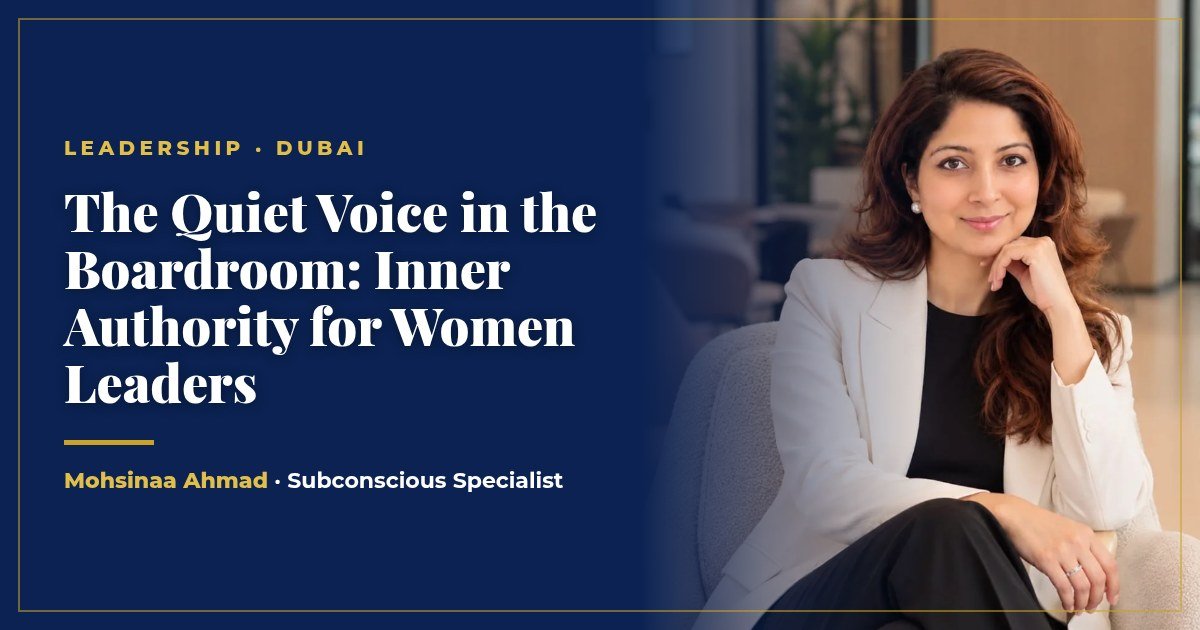
Mohsinaa Ahmad, founder of Quantum Leaders, is a subconscious specialist who works with women leaders, executives and entrepreneurs in Dubai and across the UAE. Her approach identifies the specific beliefs that shrink your voice under pressure, clears them, and installs a grounded sense of authority you can bring into any room.
For a structured, deeper shift in how you show up, explore the 7-Day Magnetic Identity Code. Or start with a 1:1 clarity call to talk through what happens for you in high-stakes moments.
Frequently asked questions
Is boardroom confidence something you can learn?
Skills like structuring a point can be learned. But lasting confidence comes from the beliefs underneath. When those change, the skills become easy to use under pressure.
How is this different from executive presence coaching?
Traditional executive presence coaching focuses on voice, body language and messaging. Subconscious work addresses why you hold back in the first place, so the external changes last.
Do you work with women leaders outside Dubai?
Mohsinaa works with women leaders across the UAE. The free clarity call is the best place to discuss which format suits you.
Your next chapter starts with one conversation
Book a free, confidential clarity call with Mohsinaa Ahmad, Subconscious Specialist, to explore what is really holding you back. Or join the free Quantum Leaders WhatsApp community first.